

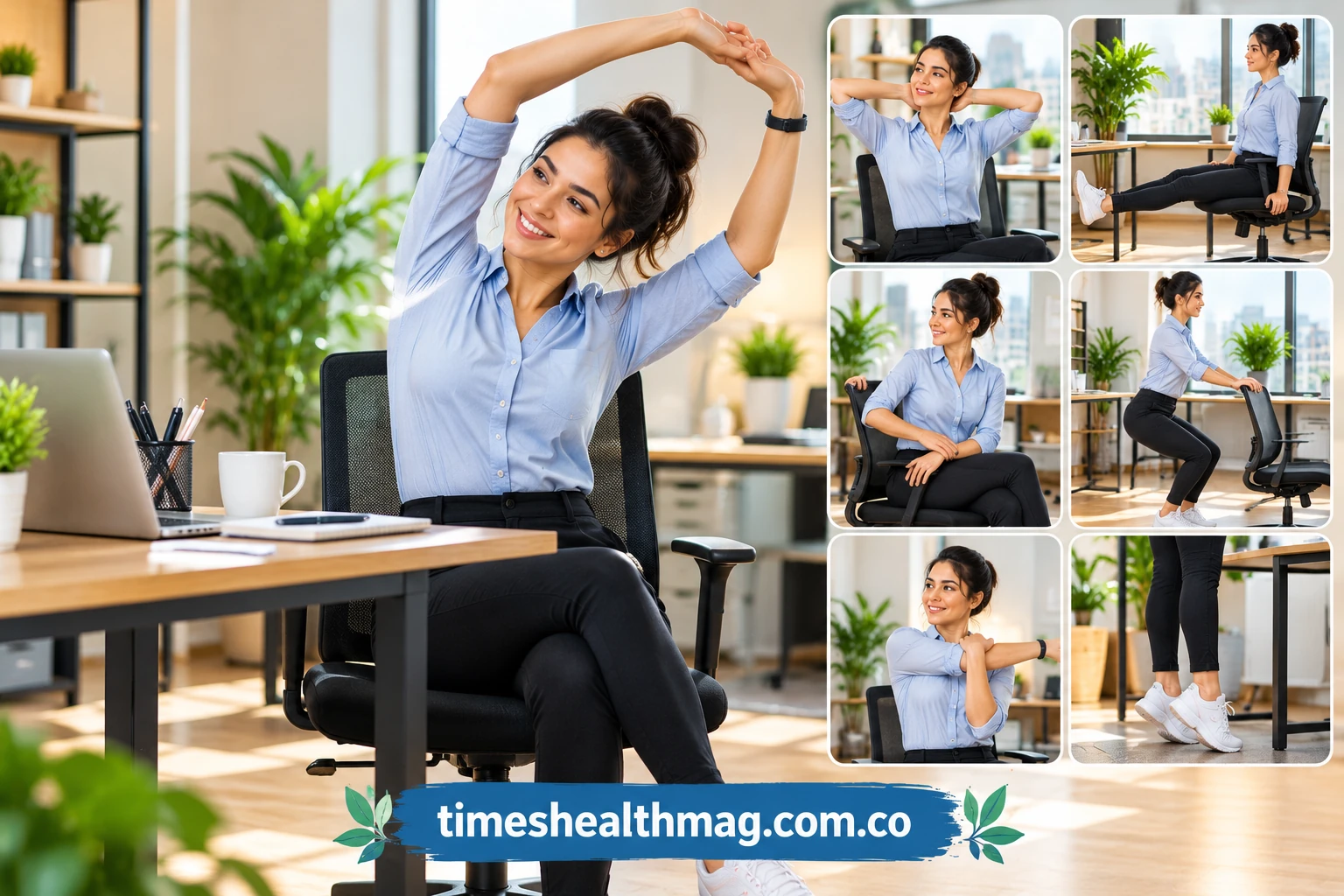
5-minute desk exercises for office workers can provide a simple way to add movement during a busy workday. These exercises can be done beside a desk with little or no equipment and can include chair stands, shoulder rolls, seated leg extensions, calf raises, and gentle stretches. Short movement breaks can also help reduce long periods of sitting, which is useful for people who spend much of their working day at a computer. The CDC supports workplace activity breaks and notes that short breaks can help employees move more during the day.
At a glance
- Workout time: 5 minutes
- Equipment: None required
- Location: Office, home office, or study area
- Best for: Breaking up long periods of desk work
- Exercise style: Gentle, low-impact movements
- Main areas: Legs, shoulders, arms, back, hips, and ankles
- Frequency: Short movement breaks can be added throughout the workday
Why Take Movement Breaks During Office Hours?
Long periods of sitting can make it easy for workers to go several hours with very little physical movement. WHO recommends limiting sedentary time and replacing some sitting with physical activity of any intensity, including light activity.
A five-minute movement break does not replace a complete exercise routine. Instead, it gives the body a chance to move during a period that might otherwise be spent sitting continuously. The CDC also notes that adults can break their physical activity into smaller periods across the week.
5-Minute Desk Exercise Routine
This routine can be completed beside a desk without changing into gym clothes. Each movement can take about 30–45 seconds, with short transitions between exercises.
1. Seated Leg Extensions
Sit toward the front of a stable chair with both feet on the floor. Slowly extend one leg until it is comfortable, pause briefly, then lower it and switch sides.
This simple movement gets the legs moving after a period of sitting. The back can remain supported, and the movement should stay controlled rather than forceful.
Time: 30–40 seconds
2. Shoulder Rolls
Sit or stand comfortably with the shoulders relaxed. Slowly roll the shoulders upward, back, and down before repeating in the opposite direction.
Shoulder rolls are easy to perform beside a computer and require very little space. They can also provide a short break from holding the upper body in one position while working at a screen.
Time: 30 seconds
3. Seated Torso Rotation
Sit upright with both feet on the floor. Place the hands across the chest or lightly on the thighs and gently rotate the upper body to one side, return to center, and repeat on the other side.
The movement should remain comfortable and controlled. There is no need to force the torso into a deep rotation.
Time: 30 seconds
4. Calf Raises
Stand behind a sturdy chair or beside the desk if support is needed. Slowly raise both heels, pause, and lower them back to the floor.
Calf raises can be performed quietly and require very little room. They are also easy to add during a short break from typing or meetings.
Time: 30–40 seconds
5. Chair Sit-to-Stands
Use a stable chair that does not roll. Stand up slowly from the chair, then sit back down with control.
This movement uses several large muscles in the lower body and adds a little more activity than seated exercises. Anyone who feels unsteady should keep a hand near a stable support.
Time: 30–45 seconds
6. Wall Push-Ups
Stand facing a clear wall and place both hands against it around chest height. Bend the elbows to bring the upper body closer to the wall, then gently press back.
Wall push-ups are a simple upper-body exercise that can be adjusted by changing the distance between the feet and the wall.
Time: 30–40 seconds
7. Ankle Circles
Sit comfortably and lift one foot slightly from the floor. Slowly circle the ankle in one direction, then switch directions and repeat with the other foot.
This is a small movement, but it is convenient for people who spend most of the day seated. It can also be performed during a short break without leaving the desk.
Time: 30 seconds
A Simple 5-Minute Schedule
| Exercise | Time |
|---|---|
| Seated leg extensions | 40 sec |
| Shoulder rolls | 30 sec |
| Seated torso rotations | 40 sec |
| Calf raises | 40 sec |
| Chair sit-to-stands | 50 sec |
| Wall push-ups | 50 sec |
| Ankle circles | 30 sec |
| Short breathing break | 20 sec |
The exact timing does not need to be perfect. The main purpose is to interrupt sitting with a few minutes of comfortable movement.
Can These Exercises Be Done at a Desk?
Yes. Most of the routine can be done without leaving the workstation. Seated leg extensions, shoulder rolls, torso rotations, and ankle circles require very little space.
For standing exercises, the area around the desk should be clear of bags, cables, loose objects, or rolling chairs. A stable surface should be used for support rather than a chair that can move unexpectedly.
CDC workplace guidance includes short physical activity breaks that can be done with little equipment and without disrupting normal work tasks.
How Often Should Office Workers Take Movement Breaks?
There is no single five-minute schedule that fits every worker. A practical approach is to avoid staying in one position for very long periods and add short movement opportunities during natural pauses in the workday.
For example, a worker might move after finishing a task, during a short break, before a meeting, or after a long period of computer work. CDC guidance for office environments notes that short breaks each hour can help reduce discomfort for people working at computers.
The goal is not to turn every work break into a workout. Standing, walking to get water, taking the stairs, stretching, or performing a few desk exercises can all add movement.
5-Minute Desk Exercises vs. a Full Workout
A short desk routine and a regular workout serve different purposes.
| 5-minute desk routine | Full workout |
|---|---|
| Easy to fit into work hours | Usually needs dedicated time |
| Requires little or no equipment | May include equipment |
| Helps break up sitting | Can provide more structured training |
| Usually low intensity | Can include moderate or vigorous activity |
| Can be repeated during the day | Often follows a planned schedule |
A desk routine should therefore be viewed as one part of an active lifestyle rather than a replacement for regular exercise.
For adults, WHO recommends 150–300 minutes of moderate aerobic activity per week, or an equivalent amount of vigorous activity, plus muscle-strengthening activity on at least two days each week.
Benefits of Adding Movement to the Workday
Short movement breaks can make an otherwise sedentary workday more active. Regular physical activity is associated with benefits for physical and mental health, while replacing some sedentary time with movement can provide health benefits.
Desk exercises may also make it easier for workers to remember to change position. This can be useful for people who spend several hours reading, writing, designing, coding, studying, or attending online meetings.
Other simple options include:
- Walking during a phone call
- Taking a short walk during lunch
- Using stairs when appropriate
- Standing during selected meetings
- Walking to speak with a nearby coworker
- Stretching after long periods at the computer
- Taking a brief walk before returning to a desk
Tips for Staying Active at Work
Set a simple reminder
A calendar reminder or routine task can help a worker remember to stand and move. The reminder does not need to signal a full workout.
Connect movement with existing tasks
Movement can be linked to activities that already happen during the day. For example, a person might stand after completing an email batch or walk briefly after a meeting.
Keep the routine simple
A complicated routine is harder to maintain during a busy workday. A few familiar exercises may be more practical than trying to remember a long list.
Change position regularly
A desk worker does not have to remain seated all day. Changing between sitting, standing, and brief walking periods can add variety to the workday. CDC guidance on working from home also recommends varying posture regularly and taking opportunities to stand.
Common Mistakes to Avoid
Exercising too quickly
Desk exercises should be controlled. Fast movements can increase the chance of losing balance or bumping into office furniture.
Using an unstable chair
A rolling or lightweight chair is not a good choice for sit-to-stands or exercises that require support. A stable chair should be used.
Stretching into pain
A gentle stretch should feel manageable. Sharp pain, sudden discomfort, dizziness, or unusual symptoms are reasons to stop the exercise.
Treating five minutes as the entire activity plan
Five minutes of movement is useful, but it does not replace regular physical activity. Short desk breaks work best alongside walking, recreational activity, sports, strength exercises, or other suitable forms of movement.
Staying in one position after the break
Returning to the same seated position for several more hours can reduce the value of the movement break. A few additional standing or walking opportunities can help keep the day more active.
Safety Tips for Desk Exercises
Office exercise should be comfortable and appropriate for the person’s ability. The floor should be clear, footwear should provide suitable support, and exercises should be performed with controlled movements.
Anyone with an injury, medical condition, balance concern, persistent pain, or other health concern should speak with a qualified healthcare professional about suitable activities. People who have been inactive for a long time can begin with small amounts of movement and gradually increase activity.
For teenagers and younger people, activity needs differ from adult recommendations. WHO recommends an average of at least 60 minutes of moderate-to-vigorous physical activity each day for ages 5–17, so a short desk routine is best viewed as one small part of daily movement.
Internal Linking Ideas for TimesHealthMag.com.co
These related articles can create useful internal connections on TimesHealthMag.com.co:
- 10-Minute Morning Workout for Beginners — link from the section about adding activity outside office hours.
- 15-Minute Full Body Workout No Equipment — link from the comparison with a full workout.
- How Many Days a Week Should a Beginner Work Out? — link from the weekly activity section.
- How to Start Working Out After a Long Break — link from the gradual activity and safety section.
- Quiet Workout for Apartment No Jumping — link from the low-impact exercise section.
- Beginner Home Workout — link from the section discussing activity outside work.
- Cardio Exercises for Beginners — link from the discussion of regular physical activity.
Using descriptive anchor text can help readers find related fitness content without interrupting the main article.
FAQs About 5-Minute Desk Exercises
Are five-minute desk exercises useful?
Yes. Five minutes of movement can help break up periods of sitting and add activity to the workday. CDC workplace guidance supports short physical activity breaks as a practical way to encourage more movement during working hours.
What is the easiest desk exercise for beginners?
Shoulder rolls, ankle circles, seated leg extensions, and gentle torso rotations are among the easiest options because they require little space and can be done seated.
Can desk exercises replace a workout?
Usually, they should be viewed as a supplement rather than a replacement for regular physical activity. Adults generally need a combination of aerobic and muscle-strengthening activity each week.
How can office workers move more without leaving their desk?
They can perform seated leg extensions, shoulder rolls, ankle circles, and gentle torso movements. Standing during suitable tasks and taking short walking breaks can also add movement.
Should office workers exercise every hour?
There is no universal requirement to perform a full exercise routine every hour. However, CDC office guidance notes that short breaks each hour can help reduce discomfort for computer workers.
What can someone do during a long meeting?
If the setting allows it, a person can stand for part of the meeting, adjust posture, move the ankles, or take a short walk before or after the meeting.
Can these exercises help people who sit for long hours?
They can help break up sedentary periods by adding movement to the day. WHO recommends limiting sedentary time and replacing some sitting with physical activity of any intensity.
Final Takeaway
5-minute desk exercises for office workers offer a practical way to add movement to a workday without requiring a gym, special clothing, or a long break. Seated leg extensions, shoulder rolls, calf raises, sit-to-stands, wall push-ups, and ankle circles can all fit into a short routine.
The bigger goal is to sit less and move more throughout the day. A five-minute break is a small step, but repeated movement opportunities can make an otherwise desk-heavy day more active.
Disclaimer
This article is published for general health and fitness information by TimesHealthMag.com.co. It is not a substitute for medical diagnosis, treatment, or individualized healthcare advice. Anyone with an injury, medical condition, persistent pain, dizziness, or concerns about physical activity should consult a qualified healthcare professional before starting or changing an exercise routine.