

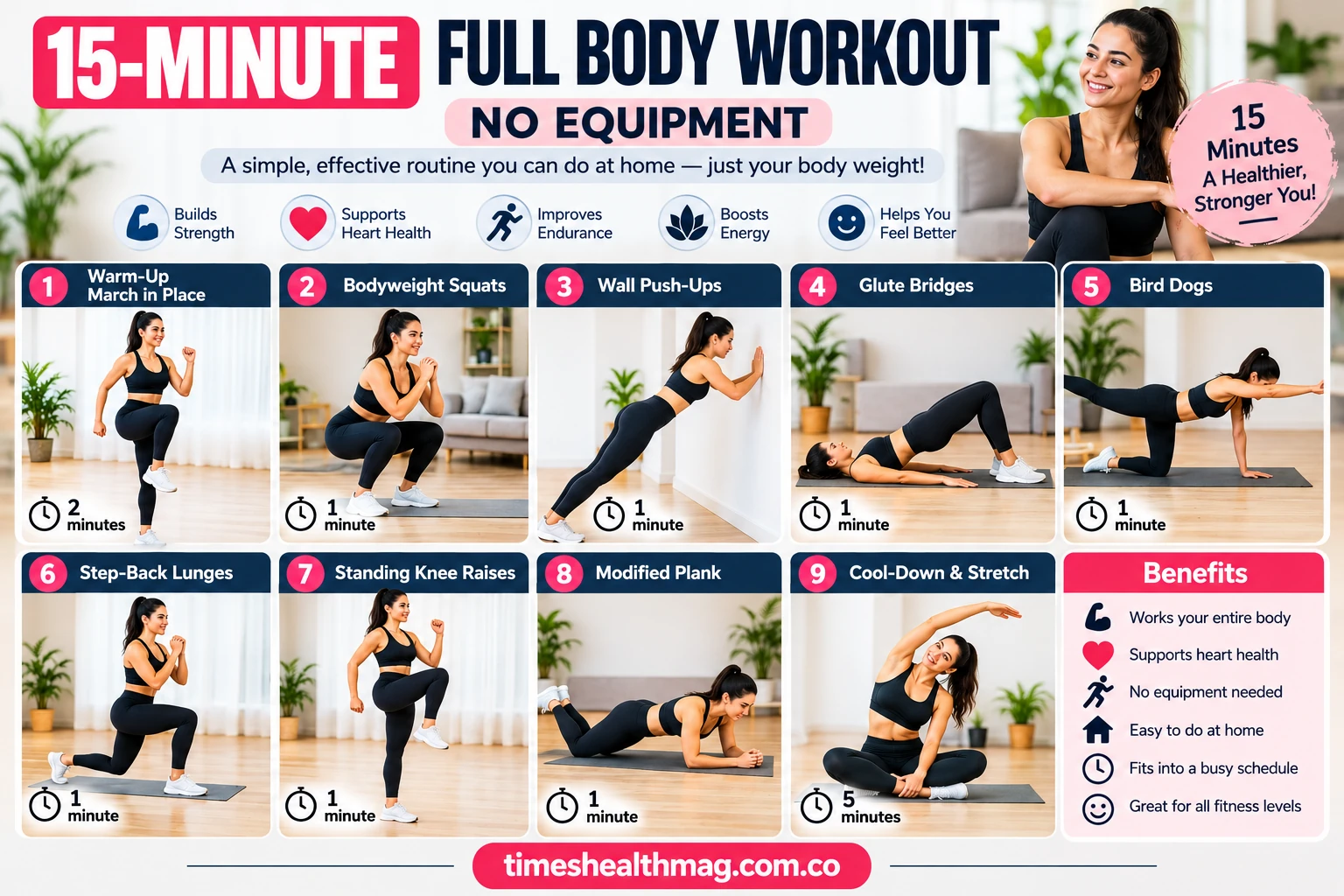
A 15-minute full body workout no equipment routine can be a convenient way to add movement to a busy day. It can combine simple bodyweight exercises that work the legs, upper body, core and cardiovascular system without requiring dumbbells, machines or a gym.
For beginners, the main goal should be learning the movements and building a regular activity habit rather than trying to exercise as hard as possible. A short workout can also complement walking, sports, cycling and other daily activities. The World Health Organization notes that some physical activity is better than none and recommends gradually increasing activity based on individual ability.
TL;DR: 15-Minute Full Body Workout No Equipment
A 15-minute full body workout no equipment can include a short warm-up, several bodyweight exercises and a gentle cool-down.
A simple session can include:
- Marching in place
- Bodyweight squats
- Wall or modified push-ups
- Glute bridges
- Bird dogs
- Step-back lunges or supported lunges
- Standing knee raises
- Gentle stretching
The exercises can be performed at a comfortable pace. Beginners can take longer breaks or use easier variations. The workout should support overall physical activity rather than replace all other movement during the week.
Quick Overview
| Part | Time | Examples |
|---|---|---|
| Warm-up | 2 minutes | Marching, arm circles |
| Main exercise 1 | 1 minute | Bodyweight squats |
| Main exercise 2 | 1 minute | Wall push-ups |
| Main exercise 3 | 1 minute | Glute bridges |
| Main exercise 4 | 1 minute | Bird dogs |
| Main exercise 5 | 1 minute | Step-back lunges |
| Short recovery | 1 minute | Easy walking |
| Main exercise 6 | 1 minute | Standing knee raises |
| Main exercise 7 | 1 minute | Modified plank |
| Cool-down | 5 minutes | Easy movement and gentle stretches |
The exact timing can be adjusted according to experience and comfort.
What Is a 15-Minute Full Body Workout?
A full-body workout uses movements that involve several major muscle groups during the same session. A short routine can include lower-body exercises, upper-body movements, core exercises and light cardiovascular activity.
No equipment means resistance comes primarily from body weight. This makes the routine convenient for home use, travel or days when someone does not have access to a gym.
A short workout should still include sensible pacing. Someone who is new to exercise may need more rest between movements, while a person with more experience may be comfortable completing the exercises with shorter breaks.
15-Minute Full Body Workout No Equipment Routine
1. March in Place — 2 Minutes
Start by standing comfortably and walking in place. Move the arms naturally and gradually increase the pace if it feels comfortable.
This is an easy way to raise body temperature before the main exercises.
People who need a lower-impact option can keep the feet closer to the floor and use a slower pace.
2. Bodyweight Squats — 1 Minute
Stand with the feet at a comfortable width. Bend the knees and hips while keeping the chest reasonably upright, then return to standing.
The movement should stay within a comfortable range. A chair can be placed behind the person as a reference point, but it should not be used for support unless it is stable.
Easier option: Use a shallower squat.
Focus: Legs and hips.
3. Wall Push-Ups — 1 Minute
Place the hands against a stable wall and step back slightly. Bend the elbows to bring the body closer to the wall, then press back.
Wall push-ups are a beginner-friendly alternative to floor push-ups.
As strength and confidence improve, a person may progress to an incline push-up using a stable elevated surface.
Focus: Chest, shoulders and arms.
4. Glute Bridges — 1 Minute
Lie on the back with the knees bent and feet resting on the floor. Gently lift the hips, pause briefly, and lower them with control.
The movement should feel controlled rather than rushed.
Focus: Hips and the muscles around the back of the legs.
5. Bird Dogs — 1 Minute
Start on hands and knees. Extend one arm and the opposite leg while keeping the torso stable, then return to the starting position and switch sides.
A smaller range of motion is fine for beginners.
Focus: Core stability, coordination and back-supporting muscles.
6. Step-Back Lunges — 1 Minute
From a standing position, step one foot backward and lower the body slightly. Return to standing and switch sides.
Anyone who finds this movement difficult can hold a stable support or use a smaller movement.
Focus: Legs and hips.
7. Standing Knee Raises — 1 Minute
Stand upright and slowly lift one knee at a time. Keep the movement controlled and use the arms naturally.
The exercise can be performed slowly for a lower-intensity session or at a slightly quicker pace if it feels comfortable.
Focus: Core control and general movement.
8. Modified Plank — 1 Minute
A beginner can use a wall or elevated surface instead of holding a full floor plank.
Keep the body comfortably aligned and avoid holding the position if it causes pain.
The goal is controlled core engagement rather than staying in the position for as long as possible.
9. Easy Movement and Cool-Down — 5 Minutes
Finish with gentle walking around the room and comfortable stretches.
Useful options include:
- Gentle shoulder movements
- Calf stretches
- Comfortable leg stretches
- Slow arm movements
- Easy walking
The cool-down should feel relaxed rather than strenuous.
How to Modify the Workout for Beginners
A beginner does not have to complete every movement at full intensity.
The routine can be modified by:
- Taking longer rest periods
- Performing fewer repetitions
- Using wall push-ups instead of floor push-ups
- Making squats shallower
- Using support during lunges
- Performing exercises more slowly
- Stopping an exercise that causes pain
WHO guidance recommends that people who are not regularly active start with smaller amounts of activity and gradually increase duration, frequency and intensity.
Can 15 Minutes Really Count as Exercise?
Yes. Fifteen minutes of physical activity can contribute to a person’s overall activity level.
However, one short workout should not be viewed as the entire weekly exercise plan. WHO recommends that adults accumulate 150–300 minutes of moderate aerobic activity per week, or an equivalent amount of vigorous activity, along with muscle-strengthening activities on at least two days each week.
For children and teenagers, the recommendations are different. WHO recommends an average of at least 60 minutes of moderate-to-vigorous physical activity each day, with muscle- and bone-strengthening activities included at least three days per week.
That means a 15-minute routine can be one part of a person’s overall movement during the day.
Benefits of a Short Full-Body Routine
A short bodyweight session can be useful because it is simple and requires little preparation.
Potential benefits include:
- More regular movement
- Practice with basic strength exercises
- Support for muscular fitness
- Improved coordination
- A break from prolonged sitting
- Convenient activity at home
- A simple starting point for beginners
Regular physical activity is associated with physical and mental health benefits across age groups.
15-Minute Workout vs. Longer Workout
A short workout and a longer workout can both have a place in an active lifestyle.
| 15-minute workout | Longer workout |
|---|---|
| Easy to fit into a busy schedule | Allows more exercises |
| Requires little preparation | Can include longer cardio sessions |
| Useful for building consistency | Can provide more training volume |
| Can be performed at home | May include gym equipment or sports |
| Suitable for a quick movement break | May suit structured training sessions |
The better choice depends on the person’s schedule, experience and activity goals.
Common Mistakes to Avoid
Moving Too Quickly
Fast repetitions can make it harder to maintain good control. Slower movements can help beginners learn proper technique.
Skipping the Warm-Up
Starting with gentle movement can help the body transition into exercise.
Trying Advanced Variations Too Soon
A basic exercise performed with control is often more useful than a difficult variation performed poorly.
Ignoring Pain
Normal exercise effort can feel challenging, but sharp, severe or unusual pain should not be ignored.
Treating a Short Workout as the Only Movement
A 15-minute workout is one activity session. Walking, sports, active recreation and other forms of movement can also contribute to overall physical activity.
How Often Can Someone Do This Workout?
Frequency depends on the person’s age, experience, health and other physical activities.
A beginner may start with a few sessions each week and use other days for walking, recreational activities or rest. Someone who already has an active routine can adjust the frequency based on recovery and the rest of their weekly activity.
There is no need to make every session difficult. A sustainable routine can include different types and levels of activity across the week.
Safety Tips
Before starting any new exercise routine, the movements should be appropriate for the person’s current ability.
Helpful safety habits include:
- Exercise on a stable surface.
- Keep enough space around the body.
- Wear comfortable clothing and suitable footwear.
- Start with easy versions of unfamiliar exercises.
- Drink fluids as needed.
- Take breaks when tired.
- Stop if an exercise causes significant pain.
- People with injuries, medical conditions or other health concerns should get guidance from a qualified healthcare professional before starting a new exercise program.
For young people, exercise should be age-appropriate, enjoyable and varied. WHO recommends gradually increasing activity for those who are not currently active.
FAQs
Is a 15-minute full-body workout enough for a beginner?
It can be a useful starting point. A beginner can use a short session to practice basic movements and build a regular activity habit.
Can this workout be done at home?
Yes. The suggested routine uses bodyweight exercises and does not require dumbbells, resistance bands or gym machines.
Can a beginner do all the exercises?
A beginner can modify the exercises based on comfort and ability. Wall push-ups, shallow squats and supported movements can make the routine easier.
Does a 15-minute workout replace regular physical activity?
No. It can contribute to overall activity, but regular movement throughout the week remains important. Activity recommendations vary by age.
What should someone do after the workout?
A person can return to normal activities, drink fluids according to thirst and allow adequate recovery. Gentle movement after the session can also be comfortable.
Is equipment necessary for a full-body workout?
No. Many basic exercises can be performed using body weight. Equipment can provide additional exercise options, but it is not required for every workout.
Final Takeaway
A 15-minute full body workout no equipment can be a simple way to add exercise to a busy day. Squats, wall push-ups, glute bridges, bird dogs, lunges and other bodyweight movements can cover several major movement patterns without gym equipment.
The key is to keep the session appropriate for the person’s age and ability, use controlled movements and build activity gradually. A short workout can be useful, but it works best as part of a broader routine that includes regular movement, recreational activity, strength work and adequate recovery.
Disclaimer
TimesHealthMag.com.co publishes health and fitness information for general educational purposes. This article does not provide individual medical advice, diagnosis or treatment. Exercise needs can vary by age, physical ability, injuries and health conditions. Anyone with a medical concern, significant injury or symptoms during exercise should speak with a qualified healthcare professional before continuing or starting a new exercise routine.