

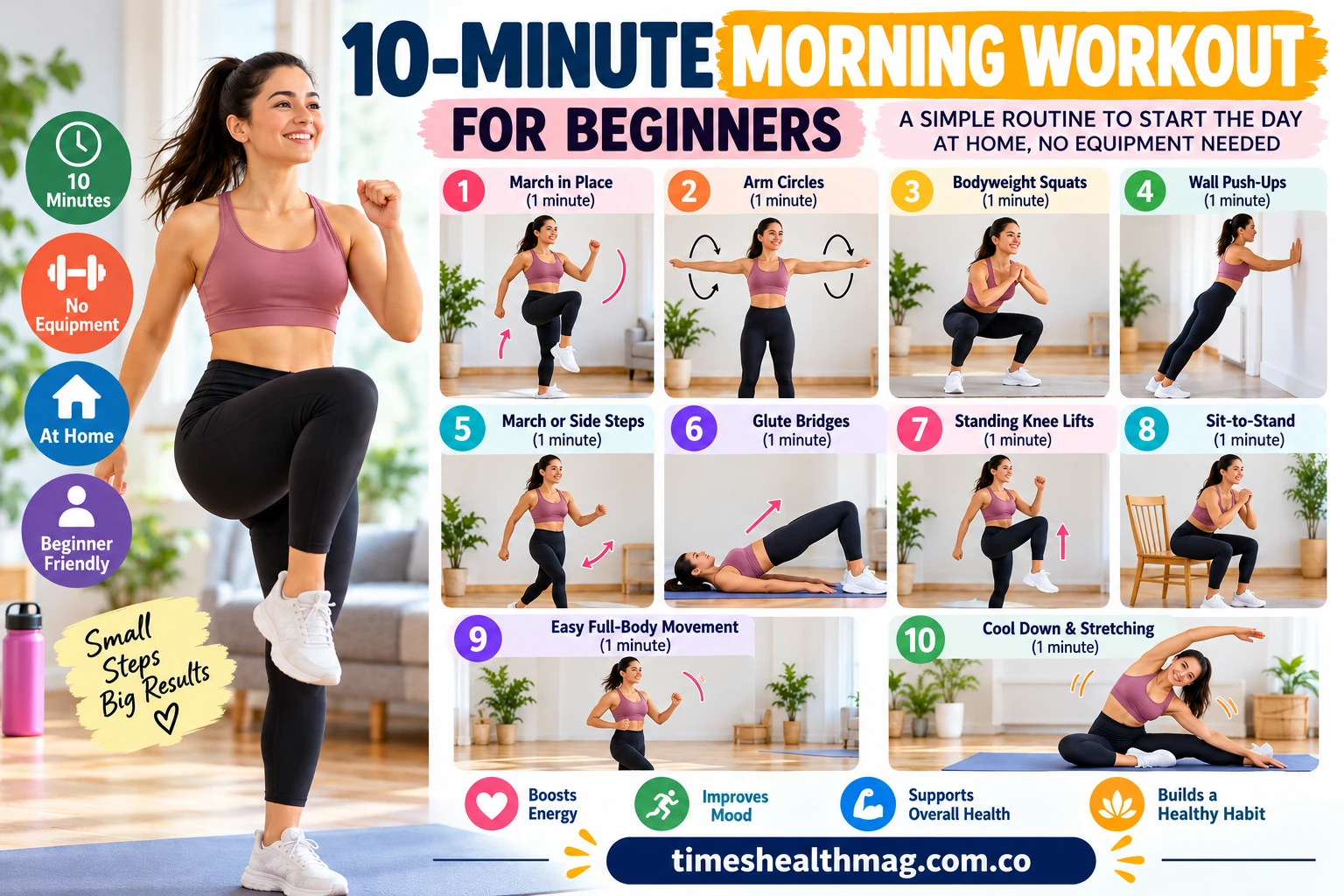
TL;DR: A 10-minute morning workout for beginners can be a practical way to add movement to the day without needing a gym or complicated equipment. A simple routine can combine gentle warm-up movements, bodyweight exercises, light cardio, and a short cool-down. The goal should be consistency and comfortable movement rather than exercising as hard as possible. For teens, adults, and older adults, the right amount and intensity of activity can differ, so the routine should be adjusted to the person’s age, fitness level, and health needs.
Quick Overview
| Workout detail | Beginner-friendly option |
|---|---|
| Total time | 10 minutes |
| Equipment | None |
| Location | Home, bedroom, living room, or outdoor space |
| Intensity | Easy to moderate |
| Main focus | Mobility, strength, balance, and light cardio |
| Best time | Morning or another convenient time |
| Suitable for | Beginners who can exercise safely |
| Main goal | Build a consistent movement habit |
A short morning workout does not need to leave someone exhausted to be useful. Ten minutes can provide a manageable starting point for someone who has been inactive, has limited time, or simply prefers shorter exercise sessions.
The key is choosing movements that can be performed with controlled technique. A beginner routine should leave enough energy for the rest of the day rather than turning the first few minutes after waking into an unnecessarily intense workout.
What Is a 10-Minute Morning Workout for Beginners?
A 10-minute morning workout for beginners is a short exercise session that uses simple movements to get the body moving after waking up. It can include exercises such as marching in place, bodyweight squats, wall push-ups, glute bridges, standing knee lifts, and gentle stretches.
The routine below does not require dumbbells, resistance bands, or gym machines. A small amount of floor space is enough.
A 10-minute session is also not meant to replace all physical activity for the day. For adults, current U.S. physical activity guidance recommends at least 150 minutes of moderate-intensity aerobic activity each week, along with muscle-strengthening activity on at least two days. Short sessions can still contribute to an active lifestyle, and activity can be divided into smaller periods throughout the week.
For children and teenagers, activity recommendations are different from adult guidelines. A short workout can be one part of daily movement rather than a complete daily exercise target.
10-Minute Morning Workout Routine
This beginner routine keeps the movements simple and allows the intensity to stay comfortable. Anyone new to exercise should focus on smooth movement rather than trying to complete as many repetitions as possible.
Minute 1: March in Place
Start with an easy march in place.
- Stand comfortably with feet about hip-width apart.
- Lift one foot at a time.
- Swing the arms naturally.
- Keep the shoulders relaxed.
- Gradually increase the pace if it feels comfortable.
The first minute is mainly about getting the body moving. It also gives the person a chance to notice how they feel before moving into strength exercises.
Minute 2: Arm Circles and Shoulder Rolls
Spend about 30 seconds on gentle arm circles and another 30 seconds on shoulder rolls.
Move through a comfortable range rather than forcing the shoulders into a large movement. This can help prepare the upper body for exercises such as wall push-ups.
If the shoulders or neck feel uncomfortable, the movement should be made smaller or stopped.
Minute 3: Bodyweight Squats
Perform slow, controlled bodyweight squats.
A beginner can start with 6–10 repetitions rather than trying to reach a fixed number.
How to perform them:
- Stand with the feet comfortable and stable.
- Keep the chest lifted without arching the back.
- Bend the knees and hips slowly.
- Lower only as far as comfortable.
- Press through the feet to return to standing.
A chair can be placed behind the person as a reference point. There is no need to squat deeply if the movement feels uncomfortable.
Minute 4: Wall Push-Ups
Wall push-ups are an easier alternative to floor push-ups and can help beginners practice the basic pushing movement.
Steps:
- Stand facing a sturdy wall.
- Place the hands on the wall around chest height.
- Step back slightly.
- Bend the elbows and bring the chest toward the wall.
- Push gently back to the starting position.
Aim for controlled repetitions. The body should move as one unit instead of the hips dropping or the shoulders shrugging.
Minute 5: March or Step Side to Side
Return to light cardio for one minute.
Marching in place works well, but side-to-side steps are another option. The pace should remain comfortable enough that the person can still speak in short sentences.
The American College of Sports Medicine notes that the talk test can help people judge aerobic intensity. Being able to maintain a steady conversation generally corresponds with moderate intensity.
Minute 6: Glute Bridges
For this exercise, lie on a comfortable surface with the knees bent and feet resting on the floor.
- Keep the feet stable.
- Lift the hips slowly.
- Pause briefly at the top.
- Lower the hips with control.
Beginners can perform 8–12 repetitions or fewer if necessary.
The movement should feel controlled rather than rushed. If getting down on the floor is difficult, this exercise can be skipped in favor of another standing movement.
Minute 7: Standing Knee Lifts
Stand upright and slowly lift one knee at a time.
The opposite hand can move toward the raised knee, but touching the knee is not necessary.
This exercise combines movement with a simple balance challenge. Beginners who feel unstable can hold a sturdy surface with one hand.
Minute 8: Sit-to-Stand
Use a sturdy chair for support.
- Sit near the front edge of the chair.
- Place the feet firmly on the floor.
- Stand up under control.
- Slowly return to the chair.
Repeat several times at a comfortable pace.
The exercise can be useful for beginners because it resembles a common daily movement. The chair also gives an easy way to reduce the range of motion if the person is still building strength.
Minute 9: Easy Full-Body Movement
Use this minute as a low-intensity movement period.
Options include:
- Easy marching
- Side steps
- Gentle heel raises
- Slow knee lifts
- Walking around the room
The purpose is to keep moving without suddenly increasing intensity.
A beginner does not need to finish a 10-minute routine completely out of breath. The session should feel manageable.
Minute 10: Cool Down and Gentle Stretching
Slow the movement gradually during the final minute.
A few gentle options include:
- Shoulder rolls
- Calf stretches
- Gentle side stretches
- Slow arm movements
- Easy walking
Stretching should feel comfortable rather than painful. A separate cool-down can be longer when someone has completed a harder workout. NHS guidance also recommends gradually reducing activity after exercise and using gentle stretches as part of a cool-down.
Why Start With Only 10 Minutes?
The biggest advantage of a short beginner workout is that it is manageable.
Someone who tries to start with a long, demanding workout may find it difficult to maintain the routine. A 10-minute session removes some of that friction.
It can also help a person discover which movements feel comfortable before increasing the duration or intensity.
However, 10 minutes should not be presented as a magic amount of exercise. The health benefits of physical activity depend on the overall pattern of movement, intensity, frequency, and individual circumstances.
For adults, even small amounts of physical activity can provide health benefits, while regular activity helps people work toward weekly activity recommendations.
Should Beginners Exercise Immediately After Waking Up?
Not necessarily.
Some people feel comfortable exercising soon after getting out of bed, while others prefer to drink water, eat breakfast, or spend some time awake first.
There is no strong reason to force every person into the same morning schedule. The most useful time for exercise is often the time that fits consistently into the person’s routine.
If the body feels stiff after sleeping, starting with gentle walking, marching, shoulder rolls, and other easy movements can make more sense than beginning with demanding exercises.
A proper warm-up is also useful before more vigorous activity. NHS guidance recommends warming up before exercise and suggests movements such as marching, heel digs, knee lifts, shoulder rolls, and gentle knee bends.
How Hard Should a Beginner Workout?
A beginner should usually start at an easy or moderate effort rather than chasing maximum intensity.
A simple guide is the talk test. If a person can speak comfortably during the activity, the intensity is generally manageable. If speaking becomes difficult, the workout may be too intense for someone who is just starting.
Another useful approach is perceived effort. ACSM describes moderate exercise as around 3–4 on a 0–10 effort scale, although individual responses vary.
The exact number matters less than paying attention to how the body responds.
Common Mistakes During a Beginner Morning Workout
Starting Too Fast
A common mistake is trying to make a 10-minute workout feel like a 45-minute gym session.
That approach is unnecessary. Beginners benefit more from controlled movements and a routine they can repeat consistently.
Skipping the Warm-Up
Going directly from lying in bed to fast or demanding movements is not a smart progression.
The first few minutes should allow the body to gradually increase activity. NHS guidance recommends warming up before more rigorous exercise.
Chasing Repetitions
There is no prize for completing the most squats or push-ups.
Poor technique can make an exercise less effective and may increase discomfort. Quality movement matters more than hitting an arbitrary repetition target.
Ignoring Pain
Normal effort and pain are different.
Muscles may feel like they are working, but sharp, sudden, or persistent pain should not be pushed through. The exercise should be stopped if pain or illness develops.
Treating Ten Minutes as the Entire Fitness Plan
A 10-minute workout is a starting point, not a complete fitness program.
Walking, recreational activities, sports, cycling, dancing, strength exercises, and other forms of movement can be added across the week.
How to Make the Routine Easier
Beginners do not need to perform every exercise in its standard form.
Several modifications can make the routine more accessible:
| Exercise | Easier option |
|---|---|
| Squats | Sit-to-stand from a chair |
| Push-ups | Wall push-ups |
| Knee lifts | Slow marching |
| Glute bridges | Fewer repetitions |
| Side steps | Smaller steps |
| Balance movements | Hold a sturdy surface |
| Cardio | Reduce the pace |
The right modification is the one that allows controlled movement without pain.
How to Progress After the First Few Weeks
Once the routine feels comfortable, progression should be gradual.
A person might first increase the number of days they perform the routine. Later, they could extend the workout to 12–15 minutes or add another short walk during the day.
Strength exercises can also become slightly more challenging over time. For adults, physical activity guidelines recommend muscle-strengthening activity at least two days per week, covering the major muscle groups.
Progress does not mean making every workout harder. It means gradually increasing activity while keeping the routine manageable.
Can a 10-Minute Morning Workout Improve Fitness?
It can contribute to better fitness when it becomes part of a broader, consistent activity pattern.
The actual result depends on the exercises, intensity, starting fitness level, frequency, and other physical activity during the week.
Someone who currently does very little activity may notice that basic movements become easier after practicing regularly. Someone who already exercises frequently may need longer or more challenging sessions to continue progressing.
That is why a short routine should be viewed as a starting point rather than a universal fitness prescription.
What to Do Before a Morning Workout
A few simple habits can make the session more comfortable:
- Wear clothing that allows easy movement.
- Exercise on a stable, uncluttered surface.
- Keep water available.
- Start slowly.
- Use supportive footwear when appropriate.
- Avoid exercising through pain.
- Give the body time to wake up if it feels stiff or tired.
The environment also matters. A clear area reduces the chance of tripping over furniture, cables, or other objects.
When Should Someone Avoid or Modify the Workout?
Not everyone should begin a new exercise routine without professional guidance.
Someone with a known health condition, recent injury, unexplained symptoms, or another health concern should speak with a qualified healthcare professional about suitable exercise. NHS guidance also recommends seeking professional advice when a person is unsure whether an exercise is appropriate for their fitness level or health situation.
Exercise should stop if a person develops significant pain, feels unwell, becomes unusually dizzy, or experiences another concerning symptom.
Pregnancy, recent childbirth, significant injuries, and certain medical conditions may also require exercise modifications.
10-Minute Morning Workout vs. Longer Workout
| Feature | 10-minute workout | Longer workout |
|---|---|---|
| Time required | Very low | Higher |
| Beginner accessibility | Usually easier | May require more adjustment |
| Equipment | Often unnecessary | May include equipment |
| Main benefit | Builds movement habit | Allows more total activity |
| Progression | Add time or difficulty gradually | More room for structured training |
| Best use | Starting point or busy days | Broader fitness routine |
The two options do not need to compete. A person can use a short workout on busy mornings and longer exercise sessions on days with more available time.
Frequently Asked Questions
Is a 10-minute morning workout enough for beginners?
It can be a useful starting point, especially for someone who currently does little exercise. It should not automatically be treated as the complete amount of physical activity needed for the week.
What is the best 10-minute morning workout for beginners?
There is no single best routine for everyone. A balanced beginner session can include gentle warm-up movements, squats or sit-to-stands, wall push-ups, marching, a simple core or hip exercise, and a short cool-down.
Can beginners exercise without equipment?
Yes. Many beginner exercises can be performed using body weight and household support such as a sturdy wall or chair.
Should a beginner exercise every morning?
Not necessarily. The appropriate frequency depends on age, current activity level, exercise intensity, and recovery. Beginners can start with a manageable schedule and gradually increase activity.
Is it better to exercise in the morning or evening?
The most practical time is usually the time that allows consistent participation. Morning exercise can be convenient for people who prefer to complete activity early, while others may feel better exercising later.
Can teenagers do a 10-minute morning workout?
A short workout can be one part of an active day for teenagers. However, teenagers have different physical activity recommendations from adults, so a 10-minute routine should not be treated as their complete daily activity target.
Should stretching be done before or after the workout?
Gentle movements can be used during a warm-up, while more relaxed stretching can be included during the cool-down. The main priority is avoiding forced or painful movements.
What if a beginner cannot complete all 10 minutes?
That is not a problem. Starting with five minutes and gradually adding time can be more practical than forcing the entire session. Consistency matters more than completing an arbitrary target on the first attempt.
Final Takeaway
A 10-minute morning workout for beginners is best treated as a simple entry point into regular physical activity. The routine can combine gentle mobility, bodyweight strength exercises, light cardio, and a short cool-down without requiring expensive equipment or a gym membership.
The main goal is not to make ten minutes as exhausting as possible. A beginner is better served by controlled movements, gradual progression, and a routine that can fit naturally into the week.
For TimesHealthMag.com.co, this topic can also serve as a useful entry page for a wider beginner fitness cluster covering warm-ups, home workouts, strength training, stretching, recovery, and daily physical activity.
Disclaimer
This article from TimesHealthMag.com.co is provided for general health and fitness information only. It is not a substitute for medical advice, diagnosis, or individualized exercise guidance. People with a medical condition, injury, concerning symptoms, or questions about whether exercise is suitable for them should consult a qualified healthcare professional before starting or changing an exercise routine.